
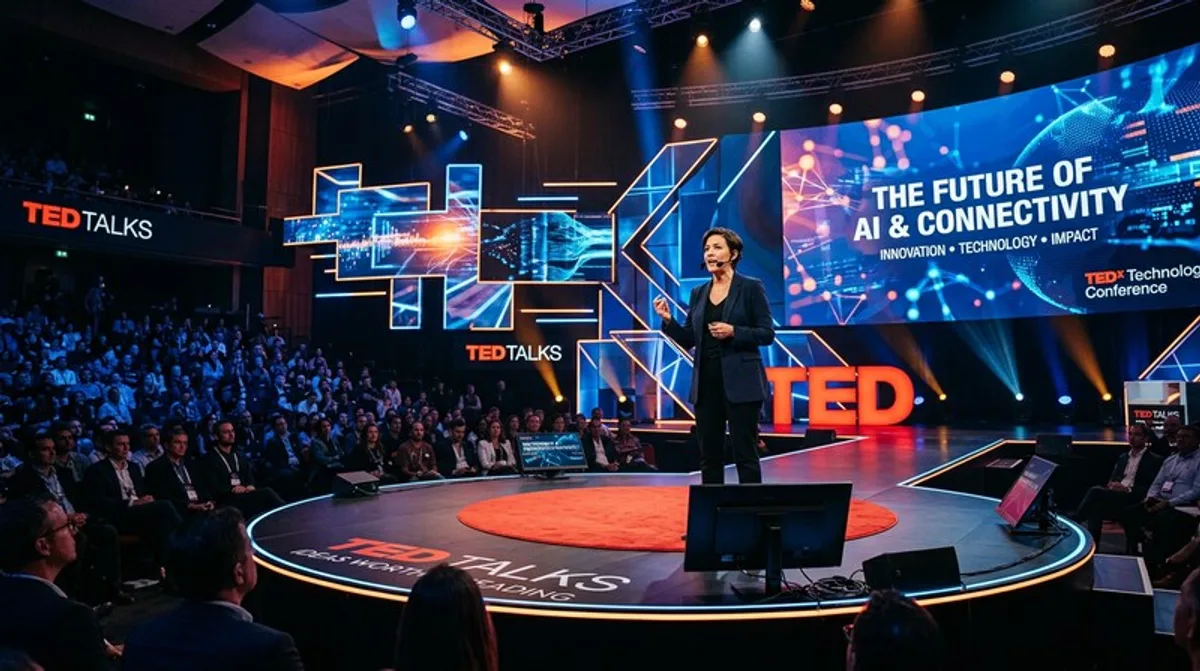
What Is TED Talks?
TED Talks is the YouTube channel for TED — the nonprofit organization behind the "ideas worth spreading" conference format that has, since its 1984 founding and especially since 2006 when talks were first made freely available online, distributed expert knowledge across the most diverse range of disciplines any single conference brand has ever achieved. With 19 million YouTube subscribers and individual talks accumulating hundreds of millions of views, the TED channel represents a specific editorial philosophy given full digital scale: one talk, one idea, 18 minutes maximum, delivered by someone who has lived with that idea long enough to compress it without losing it.
Latest videos · Open channel ↗
The format's specific commercial genius — though TED has operated as a nonprofit since Chris Anderson's Sapling Foundation acquired it in 2001 — is that the constraint IS the product. Eighteen minutes forces speakers to identify the single most important thing they know. The global streaming availability means that the right talk finds the right viewer regardless of when either was produced. Ken Robinson's 2006 talk on how schools kill creativity had been watched 72 million times by the time most TED subscribers became aware it existed, because the right viewer found it at exactly the moment they needed it.
Origins: Richard Saul Wurman, Chris Anderson & the 2006 Free-Online Decision
TED was founded in 1984 by architect and graphic designer Richard Saul Wurman as a private conference for the convergence of Technology, Entertainment, and Design — industries Wurman believed were merging in ways that no existing conference addressed. The event remained small and exclusive through the 1990s before Chris Anderson's Sapling Foundation purchased it in 2001 for what was then described as approximately $6 million. Anderson's critical decision — releasing TED talks for free online in 2006 — was the moment the conference became a media property: the first six talks posted online accumulated one million views within three months, demonstrating that the audience for carefully compressed expert knowledge delivered without jargon and without academic gatekeeping was vastly larger than conference attendance could ever serve. The 2006 decision transformed TED from a prestigious event into a public intellectual infrastructure, and the subsequent global distribution of that infrastructure via YouTube created the 19-million-subscriber channel whose individual talks have accumulated hundreds of billions of combined views.[1]
Ken Robinson, Brené Brown & What Makes a Talk Reach 70 Million Views
The most-watched TED talks share a specific quality that the format's 18-minute constraint enforces: they contain exactly one idea, expressed with enough precision that the viewer can repeat it to someone else. Ken Robinson's 2006 talk "Do Schools Kill Creativity?" — 72 million views, the most-watched TED talk of all time — works because its thesis (that education systematically suppresses creativity in children by treating mistakes as failures) is specific enough to be actionable and universal enough to apply to almost every viewer's experience. Brené Brown's "The Power of Vulnerability" (2010, 20 million+ views) works for the same reason: one research finding, expressed in language that non-researchers can use. Simon Sinek's "How Great Leaders Inspire Action" (starting with why, not what) became a business communication framework deployed across thousands of corporate training programs. The specific commercial value of the TED channel is not its subscriber count but its citation rate: TED talks are the most frequently referenced online content in educational, professional, and therapeutic contexts, which creates organic discovery and sharing that most YouTube channels cannot replicate.[2]
Channel Timeline
Brand Deals & Institutional Educational Channel Economics
TED Talks' commercial model operates under the constraints of nonprofit status and the brand equity that TED's editorial independence has built: the TED brand's credibility depends on not appearing commercially compromised, which means sponsorship integrations are structured as organizational partnerships rather than creator-style ad reads. The TED Fellows program, TED Prize, and conference sponsorships are the primary commercial mechanisms. For brands targeting the TED audience — educated professionals aged 25–55 with above-average income and a demonstrated appetite for complex ideas presented accessibly — the TED channel's brand association value is among the highest available on YouTube, because TED viewers apply above-average critical evaluation to what they watch and have specifically sought out content that respects their intelligence. Technology companies, financial institutions, consulting firms, and foundations targeting the global knowledge-worker demographic are the primary partners. For educational and institutional channel economics, see our influencer pricing guide.
Related Channels
TEDx Talks' 38 million subscribers and TED Talks' 19 million subscribers together represent the full TED distribution infrastructure: the flagship curated conference channel and the distributed global-events channel, both serving the same ideas-worth-spreading audience at different points in the editorial spectrum from quality control to volume. Veritasium's single-creator science investigation format and TED's multi-speaker conference format both represent YouTube's most successful attempts to make rigorous expert knowledge accessible to a general audience — both proving that the audience for genuinely complex ideas, presented without condescension, is much larger than the educational establishment had assumed.
Sources
- 1 The New Yorker -- Chris Anderson's TED: How a Conference About Convergence Became a Global Knowledge Infrastructure (2012)
- 2 Harvard Business Review -- What Makes a TED Talk Go Viral: The 18-Minute Constraint, the Single Idea, and Why Some Talks Reach 70 Million Views (2016)
Platform Statistics
Channel Growth History
| Year | YouTube Subscribers | Monthly Views | Est. Annual Earnings |
|---|---|---|---|
| 2024 | 0 | 0 | — |
| 2018 | 0 | 0 | — |
| 2012 | 0 | 0 | — |
Data sourced from Social Blade & public estimates. Updated annually.
Estimated Sponsorship Rates
Market estimates — actual rates vary by deal structure & exclusivity
Brand Deals & Sponsorships
| Brand | Year | Deal Type | Source |
|---|