Who Is Casey Neistat?
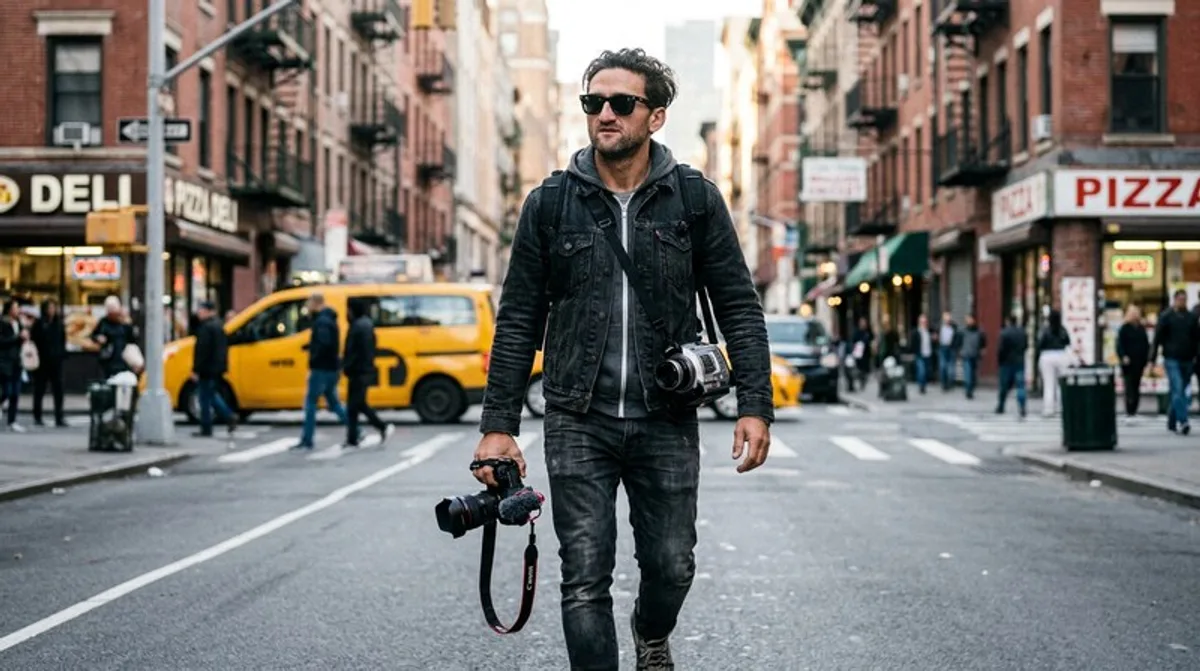
Casey Neistat is the filmmaker who invented the modern daily vlog aesthetic — raw, cinematic, New York City as permanent backdrop, Sony RX100 as instrument. Before Neistat, vlogging was bedroom content. After Neistat's 2015–2016 daily vlog run, it was a legitimate cinematic form with its own visual grammar. He sold his social media app Beme to CNN for $25 million in 2016 while his channel was still growing. He built a studio, published a memoir, and has maintained one of YouTube's most distinctive creative voices across more than a decade of irregular uploads — an accomplishment that most daily vloggers cannot replicate even with daily discipline.[1]
Neistat matters to anyone studying influencer rates and creator economics because he represents one end of the value spectrum: a creator whose cost per video (equipment, editing, time) is dramatically higher than peers at his follower count, but whose sponsorship rates command a corresponding premium because his audience is older, more affluent, and more purchase-intent-driven than the typical gaming or lifestyle creator demographic.
Early Life & Background
Casey Owen Neistat was born on March 25, 1981, in Gales Ferry, Connecticut. He dropped out of high school at 17, had a son by 19, and was living below the poverty line in New York City in his early twenties — facts he has narrated extensively in his own content and that form the origin story his audience knows well. He has described his motivation as having no acceptable alternative to success, a framing that resonates particularly with self-made entrepreneur audiences.[2]
His first notable work was a short film iPod's Dirty Secret (2003), co-created with his brother Van, which critiqued Apple's iPod battery replacement policy and went viral before "going viral" had a name — the video spread through email forwarding and early blog networks, generating millions of views and a settlement from Apple. The incident established a pattern: Neistat has consistently used filmed creative work as a vehicle for cultural commentary, rather than treating filmmaking as entertainment separate from his life.
Film Career & Early YouTube (2008–2015)
Neistat spent his twenties building a film career through experimental projects, commercial work, and a partnership with HBO that produced the short film series The Neistat Brothers — an eight-episode documentary style series about his relationship with his brother Van. The HBO work gave him professional broadcast credibility and a network of industry relationships that later made his creator-to-brand partnerships operate at a higher rate level than most YouTube advertisers paid.[3]
He launched his YouTube channel in earnest around 2010–2011 and built a consistent if modest following through short films, travel content, and essays. The channel was notable for production quality — handheld but technically proficient, with music licensing that treated YouTube as a cinematic medium rather than a screen recording — but had not yet achieved the scale that his later daily vlog era would create.
The Daily Vlog Era (2015–2016)
In March 2015, Neistat began uploading a daily vlog — a 5–15 minute film of his day in New York City, shot with a Sony RX100 and edited with a visual style that made mundane events (skateboarding to a meeting, taking a flight, filming something on the street) look like scenes from an indie film. He uploaded daily for 534 consecutive days, a run that generated an enormous audience and created the aesthetic template that thousands of subsequent vloggers consciously or unconsciously replicated.[4]
The vlog's success rested on a specific combination: Neistat's life in New York City was genuinely interesting (busy creative schedule, access to interesting people and events), his production quality was consistent with his filmmaking background, and his editorial instinct for when something was worth filming and when to skip it was sharp. Not every day was equally eventful, but the worst daily vlogs were still more cinematically competent than most creators' best work.
Career Timeline
Beme & CNN
In 2015 Neistat co-founded Beme, a social video app built on the concept of unedited, authentic sharing — a direct counter to Instagram's filtered aesthetic. The app was acquired by CNN in 2016 for a reported $25 million. Neistat joined CNN as part of the acquisition to help build a digital content operation targeting younger audiences. The CNN venture ended in 2018 when the Beme news team was shut down, but Neistat retained the acquisition proceeds and the professional connections the arrangement created.[5]
368 & The Creator Studio Model
In 2018, Neistat founded 368 — a physical creative studio in New York that he described as a collaborative space for creators who needed access to equipment, editing infrastructure, and a community of professionals. The studio hosted residencies, produced commissioned content, and operated as both a production company and a creative community center. The concept predated by several years the emergence of dedicated creator campuses that larger studios and platforms have since built.[6]
Brand Deals & The Premium Filmmaker Rate
Casey Neistat commands rates that his subscriber count alone does not predict because his commercial value is priced on audience quality rather than audience quantity. At 12.5M subscribers, his estimated YouTube integrated rate is $200K–$400K per video — among the highest CPM values in non-gaming creator categories — because his audience over-indexes in 25–45 male professionals with above-average disposable income and documented technology, travel, and premium lifestyle purchase behavior. The Nike "DO WHAT YOU CAN'T" film set the market reference point for this category: a brand partnership treated as a creative film commission, not an ad read, that generated press coverage and sharing behavior orders of magnitude above standard sponsored content performance. For current benchmarks on lifestyle and filmmaker creator rates, see our YouTube influencer pricing guide.
The principle his brand deal model demonstrates is that production quality has a commercial ceiling effect: the brands willing to pay the premium rates his output justifies are those for whom the creative quality of the content itself is the product — travel, premium tech, luxury automotive. Samsung, Emirates, Nike, and Red Bull have all appeared in his content at rates that reflect a commissioned film model rather than a traditional influencer placement. The Beme acquisition — $25M from CNN for a content app before it reached meaningful scale — confirmed that his commercial value extended beyond YouTube rates into the broader media acquisition market. Compare filmmaker creator rates and deal structures in our celebrity influencer pricing breakdown.
Related Creators
Casey Neistat's creative position in the YouTube ecosystem is genuinely singular, but there are useful structural comparisons. MKBHD (Marques Brownlee) occupies an adjacent position in the premium creator market — both are associated with high-quality visual production, older and more affluent demographics than gaming or entertainment creators, and brand partnerships with technology and premium lifestyle companies. Where Neistat's currency is cinematic storytelling, Brownlee's is technical credibility; both command above-market rates for the same underlying reason — audience trust translates directly to purchase decisions. Mark Rober and Neistat share a commitment to production quality and content where genuine skill is visible — Rober in engineering execution, Neistat in filmmaking craft — and both prove that creator audiences will sustain engagement with irregular upload schedules when the quality floor remains high. Ryan Trahan represents the next generation of the entrepreneurial storytelling format Neistat helped define: personal stakes, real consequences, and enough production craft to make daily life feel cinematic — a direct creative lineage even where the content categories diverge.
Sources
- 1 The New York Times — Casey Neistat Made the Daily Vlog. Now He's Figuring Out What Comes Next (2017)
- 2 Forbes — Casey Neistat: Dropout, Filmmaker, YouTube Star (2016)
- 3 Variety — HBO's "The Neistat Brothers" (2010)
- 4 WIRED — The Daily Vlog: How Casey Neistat Created YouTube's Most Influential Format (2016)
- 5 Wall Street Journal — CNN Buys Beme for $25 Million (2016)
- 6 Fast Company — Inside 368, Casey Neistat's Creator Studio (2019)
Platform Statistics
Channel Growth History
| Year | YouTube Subscribers | Monthly Views | Est. Annual Earnings |
|---|---|---|---|
| 2026 | 12.5M | 20M | $960K – $3.6M |
| 2022 | 12M | 22M | $960K – $3.4M |
| 2019 | 9M | 30M | $960K – $3.0M |
| 2017 | 6M | 80M | $1.2M – $3.6M |
| 2015 | 1M | 20M | $240K – $960K |
Data sourced from Social Blade & public estimates. Updated annually.
Estimated Sponsorship Rates
Market estimates — actual rates vary by deal structure & exclusivity
Brand Deals & Sponsorships
| Brand | Year | Deal Type | Source |
|---|---|---|---|
| CNN / Beme | 2016 | Acquisition ($25M) | New York Times |
| Nike | 2017 | Collab Video | Creator Disclosure |
| Samsung | 2018 | Sponsored Film | Creator Disclosure |
| AmEx | 2019 | Campaign | Creator Disclosure |
Frequently Asked Questions
Casey Neistat's real name is Casey Owen Neistat.
Casey Neistat was born on March 25, 1981, and is 45 years old as of 2026.
Casey Neistat's net worth is estimated at $16 million, based on platform ad revenue, brand partnerships, merchandise, and business ventures. This is an estimate — exact figures are not publicly disclosed.
Casey Neistat is 6'0" (183 cm) tall.
Casey Neistat's wife is Candice Pool.
Casey Neistat is American, born in Gales Ferry, Connecticut, USA.
Casey Neistat started creating content in 2010 with "iPod's Dirty Secret" (2003) — short film about Apple's non-replaceable iPod battery that went viral before YouTube existed, making Casey one of the first internet video creators.
Casey Neistat — Official Social Media & Links
All accounts below are the verified official profiles for Casey Neistat. Follower counts are approximate and updated periodically.
Sponsorship Rates & Booking
- Youtube: 12.5M followers
- Instagram: 4M followers
- Twitter: 3M followers